
Capturing biology as disease changes
Autoimmune flares often occur between clinic visits, when important biological changes can go unmeasured. Evidation's temporal omics platform links symptom-triggered, at-home biospecimen collection with longitudinal symptom reports, wearable measurements, and clinical history—helping researchers investigate disease mechanisms, potential biomarkers, and therapeutic targets.
Why timing matters
Fixed sampling schedules can miss important changes in disease activity. Collecting biospecimens around participant-reported flares and recovery allows researchers to study molecular signals in the context of symptoms, physiology, and clinical history from the same individual.
Ongoing engagement
Daily signals between visits
- Participants report symptoms through daily at-home assessments
- Wearables provide longitudinal measurements alongside symptom reports
- Clinical history adds context to each participant's timeline
Event-triggered sampling
Biospecimens timed to disease changes
- Participant-reported symptom changes can trigger sample collection
- Participants collect specimens at home rather than relying only on clinic visits
- Sampling spans baseline, reported flare, and recovery
Data linkage
Biology next to lived experience
- Link molecular measurements with symptoms, wearables, and clinical history
- Examine molecular signals around reported flares and recovery
- Provide longitudinal, multimodal context for AI research
PACE: temporal omics in rheumatoid arthritis
Evidation's Precision in Autoimmune Condition Evidence (PACE) pilot brings event-triggered, at-home biospecimen collection into longitudinal rheumatoid arthritis research. By linking samples collected around participant-reported flares and recovery with daily symptoms, wearable measurements, and clinical history, PACE demonstrates a new way to study disease as it changes.
Participants
29
people with rheumatoid arthritis
Recruited from Evidation's ongoing autoimmune research cohort and followed for about 60 days.
Daily engagement
1,300+
daily symptom assessments
Daily participant-reported symptoms informed the timing of at-home blood collection.
Molecular readout
251
inflammation-associated proteins
Exploratory analyses will examine within-person changes in these proteins across baseline, reported flare, and recovery.
Data collected in PACE
Daily symptoms
Daily participant-reported symptoms.
At-home blood samples
Collected at baseline, reported flare, and recovery.
Genetics
Baseline genetic sample.
Wearables
Activity, sleep, and other wearable measurements.
Clinical history
Available clinical history.
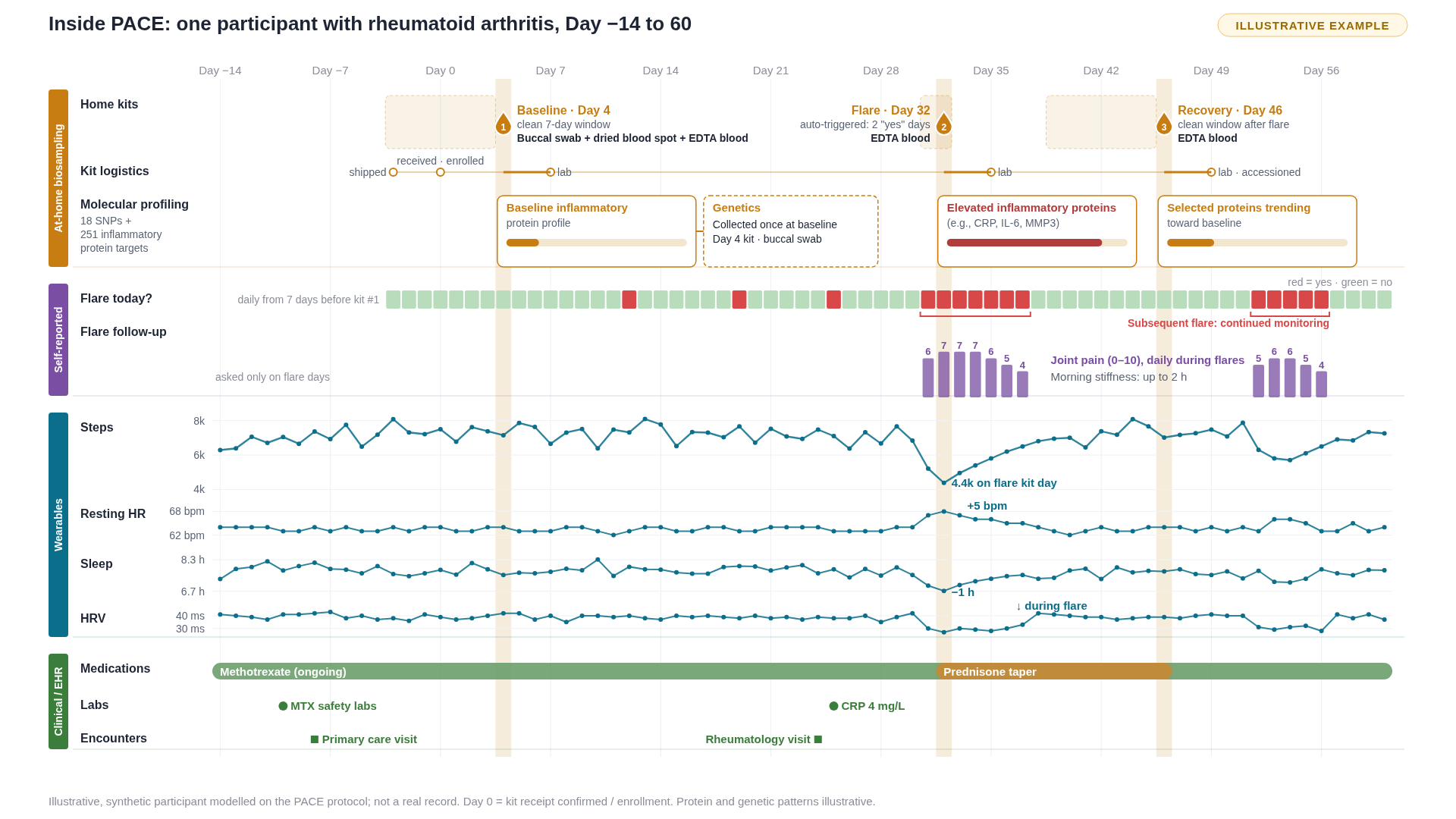
The illustration below brings these data together in a single participant's timeline, showing how symptom reports, wearable measurements, clinical history, and at-home samples can be connected over time.
A new way to study autoimmune disease
PACE shows how biospecimen collection can be timed to changes participants report in everyday life. Linking those samples with longitudinal health data creates opportunities to investigate within-person molecular changes during flares and recovery.
Demonstrated capability
Decentralized, symptom-triggered biosampling
- At-home collection timed to participant-reported flares
- Daily symptom assessments guide sampling windows
- Molecular and longitudinal health data linked within each participant
Molecular research
Study biology across flare and recovery
- Exploratory analyses planned for 251 inflammation-associated proteins
- Within-person comparisons across baseline, flare, and recovery
- Investigate how molecular signals relate to symptoms and daily functioning
Research opportunity
Advance biomarker and disease research
- Explore molecular patterns to generate new research hypotheses
- Identify candidate biomarkers for further study
- Inform research into disease mechanisms and therapeutic targets
What research teams can do with it
By connecting molecular measurements with everyday health data, researchers can investigate disease mechanisms, identify candidate biomarkers and therapeutic targets for further study, and develop models of changing disease activity.
Translational research
Study molecular signals in context
- Relate molecular changes to disease activity, flares, and recovery
- Compare the same person across disease states, not only across groups
AI-enabled biology
Find patterns across modalities
- Combine molecular, symptom, wearable, and clinical data on one timeline
- Generate hypotheses about the biology behind changes people experience
Study design
Plan studies around biological change
- Time sample collection to meaningful changes in disease experience
- Recruit from an engaged autoimmune cohort with ongoing symptom reporting
What makes the data different
How event-triggered molecular sampling adds context beyond fixed-visit collections.
Built to study autoimmune disease at scale
PACE builds on Evidation's ongoing autoimmune research program, where thousands of participants contribute longitudinal data on symptoms, treatments, and flares—as frequently as daily. Through direct relationships with more than 100,000 people diagnosed with autoimmune conditions, Evidation can recruit additional participants and extend event-triggered molecular research across conditions.
Active research cohort
Thousands contributing data
Thousands of people across at miltiple autoimmune conditions contribute longitudinal data on symptoms, treatments, and disease experience.
Frequent flare tracking
Symptoms captured as often as daily
Participants report symptoms and flare experiences as frequently as daily, supporting research into how disease changes over time.
Scale and expansion
100,000+ people to engage
Direct relationships with people diagnosed with autoimmune conditions support future recruitment and molecular studies.
Frequently asked questions
Explore event-triggered biospecimen collection, linked health data, and the PACE rheumatoid arthritis pilot.
What is temporal omics?
Temporal omics investigates how molecular measurements change over time and around health events. Temporal proteomics focuses specifically on proteins. Evidation links event-triggered biospecimen collection with longitudinal health data so researchers can study molecular changes within the same person.
Why does the timing of biospecimen collection matter in autoimmune research?
Autoimmune symptoms can fluctuate between clinic visits. Sampling at baseline, during a participant-reported flare, and after recovery helps researchers investigate molecular changes associated with different stages of disease activity.
How does Evidation identify when to collect biological samples?
Participants complete regular symptom assessments. When responses meet prespecified study criteria, they can trigger at-home collection, aligning sampling with reported health changes instead of only scheduled visits. A participant-reported flare does not necessarily indicate independently confirmed inflammation.
How does at-home blood collection work?
Participants use provided kits to collect small blood samples at home and return them for laboratory processing. In PACE, this approach enabled sampling around baseline, participant-reported rheumatoid arthritis flares, and recovery without a separate clinic visit for each collection.
What data can be linked with temporal omics measurements?
Evidation links molecular measurements with information from the same participant over time, including symptoms, patient-reported outcomes, wearable measures such as activity and sleep, and available clinical records. Together, these data put biological measurements in the context of everyday health.
What has Evidation demonstrated through the PACE pilot?
PACE demonstrated a decentralized, symptom-triggered sampling approach in rheumatoid arthritis. Over approximately 60 days, 29 participants completed more than 1,300 daily symptom assessments that informed at-home collection timing. Exploratory analyses of 251 inflammation-associated proteins across baseline, flare, and recovery are planned.
How could temporal omics support biomarker discovery and AI research?
Time-aligned molecular, symptom, wearable, and clinical data could help researchers investigate flare biology, identify candidate biomarkers, and develop AI models of changing disease activity. These applications will require further research and validation.
Longitudinal cohorts across key conditions
Engaged, recontactable cohorts with time-aligned wearable, survey, and clinical data across 100+ conditions.





 VACCINES & INFECTIOUS DISEASE
Flu and respiratory illness, symptom follow-up, and vaccination journeys

Explore a temporal-omics collaboration
Tell us the disease area and biological question you're working on. Our scientists will walk you through how event-triggered sampling and real-world data could fit your research.